bootstrap html templates
MST

How to become an airline pilot

MST often receives questions about “How to become an airline pilot.” To help, we’ve outlined the general pathway below. Keep in mind that both the cost and duration vary significantly depending on the country and the chosen training school. Importantly, a higher price does not always guarantee better training quality.

Becoming an airline pilot requires obtaining a series of licenses and ratings, building sufficient flight hours, and meeting medical and educational requirements. The typical progression involves earning a Private Pilot License (PPL), an Instrument Rating, a Commercial Pilot License (CPL), and ultimately an Airline Transport Pilot License (ATPL).

• Private Pilot Familiarization
• Instrument Flying Familiarization
• MST Reference Documents
• Learn to Fly using Flight Sim
> How to become an airline pilot

Rev: 820252

Lets go through details

• Decide if you want to fly for fun, for hire, or for an airline.
• Determine the type of aircraft you want to fly (single-engine, multi-engine, etc.). 

• Medical Certificate:
Obtain a First Class Medical Certificate from an Aviation Medical Examiner, as this is required for airline pilots.
• Educational Requirements:
A diploma or equivalent is generally required, but a degree can be beneficial, especially for major airlines.  

• This is the first step for any pilot, allowing you to fly for recreation.
• You'll need to complete ground school, flight training, and pass both written and practical exams.

• Instrument Rating:
This allows you to fly in various weather conditions using instruments.
• Commercial Pilot License (CPL):
This license is required to fly for hire, and it involves more advanced training and flight hours.
• Multi-Engine Rating:
This allows you to fly multi-engine aircraft, which are commonly used by airlines.
• Build Flight Hours:
You'll need to accumulate a significant number of flight hours to meet the requirements for the ATPL, often through commercial flying or becoming a flight instructor.  

• This is the highest level of pilot certification and is necessary to fly for airlines.
• It requires extensive flight experience and passing both written and practical exams.

• Research reputable flight schools and instructors to ensure quality training.
• Consider factors like location, cost, and training methods.

• Building flight hours by teaching can be a great way to gain experience and potentially work out deals with flight schools to have your certificates paid for.

• Attend aviation events, network with other pilots, and research job opportunities.
• Apply for positions with regional airlines to gain experience and build towards a major airline. 

• Aviation is a constantly evolving field, so it's important to stay up-to-date on regulations, procedures, and technologies.
• Consider further training and upgrades as you progress in your career.

Step-by-Step Guide

Becoming an airline pilot is demanding, expensive and time consuming. As you can imagine the role of an airline pilot is a safety critical role, so you will have to undertake an extremely difficult and comprehensive training course to ensure that you are fully qualified to fly commercial airliners, responsible for the safety of the crew and passengers and the competence to take control of an expensive aircraft. Regardless of the difficulty, this is no reason to be put off. As once you have achieved your goal the benefits and salary are excellent. Also, having the opportunity to travel to different parts of the world and be paid for it at the same time, will be extremely appealing to many of us.

To be eligible to fly airliners for a commercial airline, you will need to hold an ATPL (Airline Transport Pilot License). However, getting to this stage will take a considerate amount of commitment and funding, as pilot training is costly.
To be considered for pilot training you will be required to have at A Levels, but a degree can be beneficial, especially for major airlines. English, Maths and physics are desirable subjects, as the training requires a good level of understanding in these.

There are a number of routes for training you can take which include the following:
 - Integrated training – This is a full-time course which takes about 18+ months to complete and is a mixture of classroom-based tuition and flying time in the cockpit. This is the most expensive route and will cost the most.
 - You can also take what is call Modular training which allows you to take the same course, but in smaller chunks, more of a pay as you go model. Although more affordable, the cost is still considerate and will also involve more studying at home, potentially this route could take longer depending on your personal circumstances, especially if you are working to fund the training. This route could also require you to already have a PPL (Private Pilot’s License) so please check with the course provider first.
 - In some circumstances you may be fortunate to receive partial or full sponsorship from an airline to fund your training. However, as you can imagine the competition for spaces would be fierce, so you would have to prepare comprehensively to be successful with this entrance. Also, the number of places depends on how well the industry is performing and how busy the airlines are. Based on growth in international travel, there is a much better scope currently. It is certainly worth checking airline company websites for information on any opportunities and what their eligibility criteria is.

Before applying for any course, there is one thing you should most definitely consider. All commercial pilots will be required to pass a class one Civil Aviation Authority (CAA) medical. If you are unable to pass this medical, you will not be eligible for the ATPL, regardless on how well you do in the training.

What are the steps required to become a commercial pilot?
Becoming a commercial pilot is a structured process that involves several key steps, each designed to build your skills and experience as you progress toward a professional pilot career. The journey begins with flight training and earning a private pilot certificate, which introduces you to the fundamentals of flying and aviation safety. As you gain flight hours and experience, you’ll move on to more advanced training, including obtaining a commercial pilot certificate. Accumulating sufficient flying hours is essential to qualify for airline pilot positions, and many aspiring pilots build these hours by working as flight instructors. This certification allows you to be compensated for your flying and opens the door to a variety of career opportunities in aviation. Throughout your training, you’ll work with experienced instructors, log valuable flight hours, and use a simulator to practice flight procedures and emergency scenarios in a controlled environment, helping you develop the knowledge and skills needed to become a successful commercial pilot. 
1

Earn Private Pilot Certificate

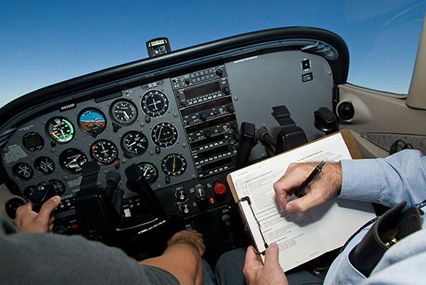
The first step in becoming a commercial pilot is to earn a Private Pilot certificate, issued by Aviation Authority. Starting in a single-engine airplane, this stage of training focuses on the fundamentals and sets the foundation for more advanced certificates and ratings.
2

Add Instrument Rating

After becoming a private pilot, the next step is to earn an instrument rating which allows a pilot to fly under Instrument Flight Rules (IFR) and in all kinds of weather.
3

Obtain Commercial Pilot Certificate

Next is earning a Commercial Pilot certificate. Pilots must meet specific experience requirements and fly to a higher standard in order to become commercial pilots, which ultimately allows them to legally be paid to fly.
4

Obtain Flight Instructor Certificate

Once the commercial pilot requirements are satisfied, obtain a Flight Instructor certificate. Becoming a certificated flight instructor (CFI) allows pilots to earn a living by flying, while they earn the flight experience required by the airlines.
5

Add Multi-Engine Rating

To fly large passenger airliners, pilots must add multi-engine privileges to their commercial pilot certificate. Adding a multi-engine rating to the Commercial Pilot certificate is the final step before building experience to meet hiring minimums.
6

Gain Experience & Interview

- Flight instruction to gain the type of quality & relevant flight experience necessary to meet the requirements of the Airline Transport Pilot License (ATPL) certificate, which commercial pilots are required to hold and includes a minimum of 1,500 hours total flight time.
- Between 500 and 1,500 hours of total flight time, interview with your desired airline for the position of First Officer. Airlines typically conduct both a technical interview and an HR interview. - Upon successful completion, you will receive a conditional offer of employment.
7

Commercial Pilot Job

Upon meeting the requirements of the ATPL certificate, you are eligible to fly as an airline pilot and will meet the hiring minimums of most regional commercial airline pilot jobs.

What is...

What is a Private Pilot License?

A Private Pilot License (PPL) is the most sought-after type of pilot certification. It is actually called a Private Pilot Certificate and is similar to a driver's license for automobiles, as both are government-issued licenses granting legal permission to operate a vehicle or aircraft. A pilot's license is the certification required to legally operate an aircraft. In Sri Lanka Civil Aviation Authority sets the requirements for obtaining a private pilot license.

By earning a private pilot license, you can legally fly an aircraft for personal and non-commercial purposes. Private pilots are trained to navigate small aircraft by themselves. Flight training includes aircraft maneuvers, navigation, emergency procedures and cross-country flight planning. While people may seek the license for hobby or sport reasons, a private pilot certification is the first major milestone on the road to becoming an airline pilot.